The point of sale landscape has shifted dramatically over the past decade. Traditional POS terminals that once dominated every checkout counter are now being replaced by cloud-based alternatives that run on everyday devices. But which approach is truly better for your business? This article offers an honest comparison across the dimensions that matter most: cost, maintenance, accessibility, reliability, and growth potential.
Upfront Costs
Traditional POS systems typically require a significant capital investment before you ring up your first sale. Proprietary hardware, on-premises servers, software licenses, and installation fees can easily total several thousand dollars per terminal. For a small business with tight cash flow, that is a serious barrier to entry.
Cloud POS systems flip this model on its head. Because the software runs in a web browser, you can use hardware you already own: a tablet, a laptop, or even a smartphone. There is no server to purchase and no installation technician to hire. SmartPOS AI, for example, offers a free plan that lets you start selling immediately with zero upfront cost. Paid plans are billed monthly with no long-term contracts.
Maintenance and Updates
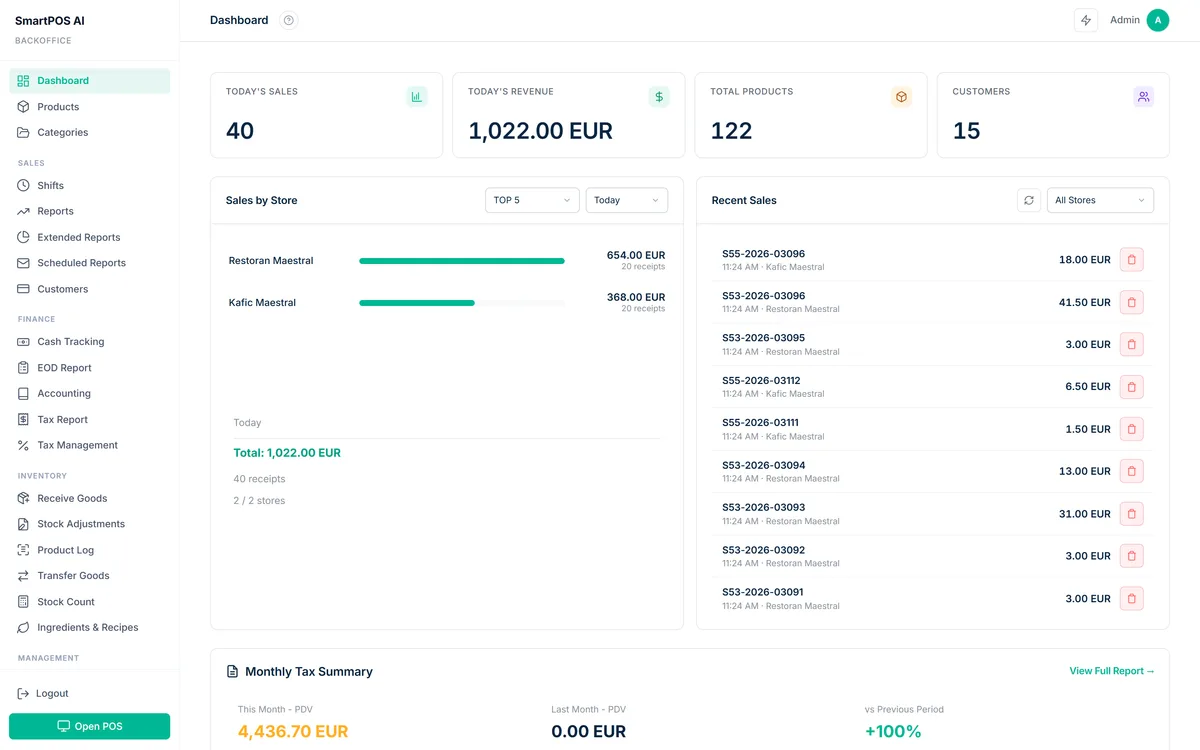
With a traditional system, software updates are your responsibility. They often require scheduling downtime, calling a technician, or manually installing patches on each terminal. If something breaks, you wait for on-site service or ship hardware back to the manufacturer.
Cloud POS updates happen automatically on the provider's servers. The next time you open the application, you are running the latest version with the newest features and security patches. There is nothing to install, nothing to schedule, and no disruption to your business. SmartPOS AI deploys updates continuously, so you always have access to the most current capabilities without lifting a finger.
Accessibility: Any Device vs Dedicated Hardware
Traditional POS software is locked to specific hardware. You cannot check your sales from home, add a product from your phone, or open a temporary register on a borrowed tablet. If the terminal fails, you are offline until a replacement arrives.
Cloud POS is device-agnostic. Log in from any browser on any operating system and you have full access to your store. Need an extra checkout lane during a holiday rush? Grab a spare tablet, open the browser, and you are live in seconds. SmartPOS AI is built as a progressive web app, which means it works on iOS, Android, Windows, macOS, and Chrome OS without a dedicated app download. See our overview of mobile POS features in 2026 for a closer look at what device flexibility means in practice.
Offline Capability
This is where many business owners assume traditional systems have the advantage. Because legacy software runs locally, it does not depend on an internet connection. That is true, but modern cloud POS platforms have closed this gap entirely.
SmartPOS AI uses a Service Worker to cache the entire application and IndexedDB to store product catalogs, prices, and tax rules on the device. When you lose connectivity, the POS continues to operate exactly as it does online. Transactions are saved locally and automatically synchronized to the cloud the moment the connection is restored. You get the best of both worlds: cloud convenience with local resilience. Read more in our deep dive on offline POS.
Multi-Location Support
Expanding to a second location with a traditional POS often means purchasing an entirely new set of hardware and configuring a separate installation. Consolidating data across locations requires manual exports, third-party middleware, or expensive enterprise add-ons.
With a cloud POS, every location connects to the same central platform. Inventory, employee records, pricing, and reports are unified in one dashboard. Opening a new store is as simple as creating a new location in the backoffice and logging in from the new site. SmartPOS AI supports unlimited locations on its higher-tier plans, all managed from a single account.
Integration Options
Traditional POS systems were designed in an era before open APIs became standard. Integrating with accounting software, e-commerce platforms, or delivery services often requires expensive custom development or proprietary connectors that lock you into a single vendor ecosystem.
Modern cloud POS platforms are built with integration in mind. SmartPOS AI offers native connections to Stripe, Square, Mollie, Xero, FreshBooks, WooCommerce, and more. A RESTful API is available for developers who need custom integrations. Consult our API documentation for full details.
Data Security
Traditional systems store data on local hardware, which means a stolen terminal or a hard drive failure can result in permanent data loss. You are responsible for backups, encryption, and physical security.
Cloud POS providers handle data security at scale. SmartPOS AI encrypts all data in transit with TLS and keeps it on servers in Germany. The database is backed up several times a day to a separate server, and a restore is tested every day, so a single failure does not put your business data at risk. Card payments are processed by your payment provider, and SmartPOS AI never stores full card numbers.
The Verdict
For the vast majority of small and mid-sized businesses in 2026, a cloud POS is the superior choice. It costs less, requires no maintenance, works on any device, scales effortlessly, and integrates with the tools you already use. The one historical advantage of traditional systems, offline operation, has been neutralized by platforms like SmartPOS AI that work flawlessly without an internet connection. If you are weighing your options, our guide to the best POS system for small business walks through every criterion that matters.
Ready to make the switch? Create a free SmartPOS AI account and experience cloud POS for yourself.